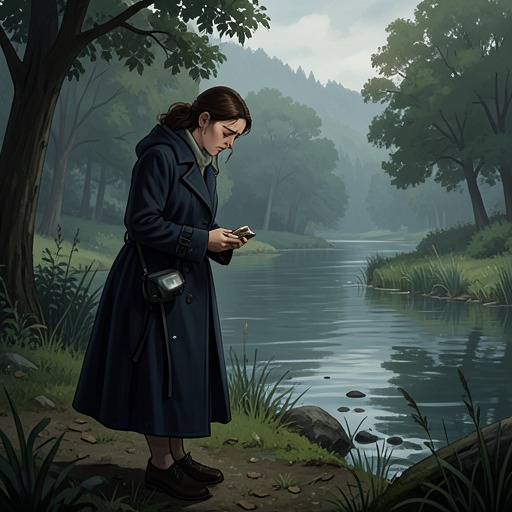
Nancy is threatened and followed, then seeks help from the State’s Attorney
Blood ShotNancy is threatened and followed, then seeks help from the State’s Attorney, an episode whose importance lies as much in what remains unconfirmed as in what Nancy reports. Before her death, she told Caroline Djiak that she had received threatening telephone calls and thought someone was following her. Nancy took the concern to the State’s Attorney’s Office, where staff said they would open a file. But neither the source of the threats nor their purpose is established, and Nancy did not tell Caroline that they were about the recycling plant. The distinction becomes consequential when Caroline’s assumption is carried into the murder investigation as a fact.
The Report and Its Uncertainties
Caroline later recalled that Nancy called her on a Tuesday morning. Nancy said she had received threatening calls and believed someone was following her. When V. I. Warshawski asked what the calls threatened her about, Caroline immediately answered that they concerned the plant. Pressed to distinguish Nancy’s own words from her interpretation, Caroline admitted that Nancy had not specifically connected the calls to it. Caroline had made the association because the plant was the last subject she and Nancy had discussed.
The account therefore contains two related but different claims: Nancy’s report of threats and following, and Caroline’s explanation of why they occurred. The first is what Caroline says Nancy actually told her; the second is Caroline’s inference. The information available does not identify who contacted or followed Nancy, and it does not establish that the recycling proposal motivated either act. Keeping those limits visible matters because the apparent connection to the plant can sound like a lead while resting, in this exchange, on Caroline’s assumption rather than on Nancy’s testimony.
Seeking Official Help
Nancy did not merely confide her fear to Caroline. According to Caroline, Nancy spoke with the State’s Attorney’s Office, which said it would open a file. Caroline did not know whom Nancy had met there. She thought it might have been Hugh McInerney, the person she and Nancy dealt with on other issues, but presented that identification as uncertain. The account thus establishes that Nancy sought official attention without resolving which staff member received her report or what investigative steps followed.
That approach to the State’s Attorney takes on added context when Caroline, under further questioning, acknowledges an earlier history. Eighteen months before this conversation, McInerney had taken statements from Caroline and Nancy concerning their problems with Steve Dresberg, a local figure involved in garbage disposal. Caroline and Nancy had testified that they received death threats because they opposed Dresberg’s PCB incinerator. This earlier episode shows that the two women had previously reported threats associated with environmental opposition. It does not, by itself, prove that Nancy’s later calls or the reported following were connected to the same dispute.
From Fear to a Misleading Accusation
The episode reaches V. I. Warshawski through Caroline’s account after Nancy has been killed. Caroline told police that Nancy was killed because of the recycling plant and that Warshawski had directed Nancy to someone for help. Warshawski confronts her with the gap between what Nancy had said and what Caroline had inferred: Nancy’s report to Caroline did not specify the plant as the subject of the threats. Caroline begins to defend her conclusion as more than a wild guess, but the basis she has supplied remains circumstantial—the plant was their last topic of conversation.
The consequences are immediate within the conversation. Warshawski points out that Caroline’s claim has implicated her to the police and redirected attention from finding Nancy’s killer toward an asserted motive that has not been verified. Caroline’s account of Nancy’s fears could have been relevant to the investigation; presenting a conjecture as Nancy’s own explanation makes it less reliable and places Warshawski under suspicion. The narrative does not confirm that the recycling plant caused the threats or Nancy’s death. Instead, it makes the difference between reported fact and assumed cause central to how the case is understood.
Earlier Threats and the Limits of the Connection
Caroline and Nancy’s testimony about threats against their opposition to Steve Dresberg’s incinerator gives the later report a plausible background, but plausibility is not confirmation. The earlier threats were associated with their opposition to the PCB incinerator; the later telephone calls and following are reported without an identified perpetrator or stated motive. The two episodes can be placed beside one another because both involve threats and Nancy’s environmental work, yet the available account does not collapse them into one continuous campaign.
That restraint shapes the event’s significance in the murder inquiry. Nancy’s decision to seek help shows that the danger was serious enough for her to bring it to the State’s Attorney’s Office, and the office’s stated response was to open a file. At the same time, the episode leaves essential questions unanswered: who threatened and followed her, what they wanted, and whether those acts had any relation to the recycling plant or to the earlier incinerator dispute. Those uncertainties are not incidental details; they mark the boundary between Nancy’s documented fear and the motive Caroline supplies after Nancy can no longer clarify her own words.